Visiting Ziebell’s Farmhouse Museum: What to See and How to Plan
Ziebell’s Farmhouse is a small, hands-on window into a German farming family’s daily life in Thomastown, and it rewards a slow visit of about an hour. It is not a big museum with glass cases and long wall texts. It is a house, a yard and a set of farm buildings that show how a settler family worked, ate and slept. Go with that expectation and you will enjoy it far more.
This guide covers what to look at inside and outside, the order that works best, and the planning steps that save you a wasted trip. If you want the wider story of the settlement first, our article on Westgarthtown and Thomastown’s German heritage gives the background. Here, we stay at the farmhouse gate.
What Kind of Place Is Ziebell’s Farmhouse?
It is a preserved family farmstead, not a purpose-built gallery. The Ziebell family were part of the German community that settled this corner of Melbourne in the 1800s. Their home stayed a working home for generations. That is why it feels lived in rather than staged.
This matters for how you visit. A purpose-built museum tells you what to think. A farmstead lets you work it out. You stand in a doorway, see how low the ceiling is, notice how close the rooms sit together, and start asking your own questions. Those questions are the real value of the visit.
I find that most people arrive expecting a quick look and stay longer than planned. The scale is small, but the detail is dense.
Why Does the Architecture Deserve Your Attention First?
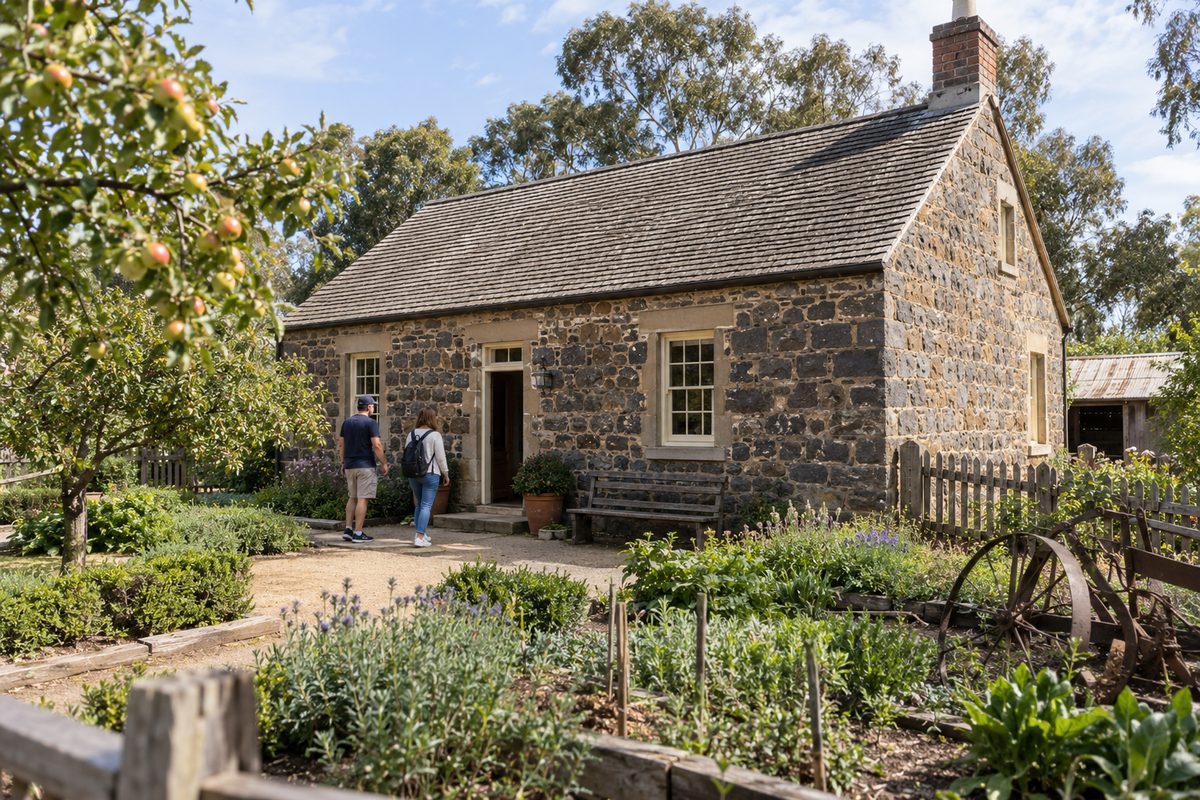
Start outside and look at the building itself. The architecture tells you who built it, what they could afford and what they brought from home. Settler houses like this were practical. They used local materials, simple rooflines and thick walls. Nothing was there for show.
Walk slowly around the outside before you go in. Look at the chimney placement, the window sizes and how the house sits on the land. Windows were small because glass was costly and winter heat was precious. The chimney sat where it could serve the rooms that mattered most.
Visitors who know German Americans’ farmstead museums in Pennsylvania or Texas often spot the shared habits straight away. German settlers in both places built compact, sturdy homes, kept the work buildings close and organised everything around the family’s routine. Seeing that pattern across continents makes the Thomastown site feel part of a bigger migration story.
Take five minutes here. It sets the frame for everything inside.
What Will You See Inside the House?
The rooms are small, and that is the point. A family lived, cooked and slept in a footprint smaller than many modern living rooms. Three spaces tell the story best, so give them the most time.
The Kitchen
The kitchen was the centre of the house. Heat, cooking, washing and talking all happened here. Look for the hearth or stove area, the benches and the tools within arm’s reach. Everything is placed for someone doing five jobs at once.
Think about the daily load. Water was carried in. Fuel was chopped and stacked. Every meal started from raw ingredients grown or raised on the property. When you see the shelves and hooks, picture the work behind each item.
The Bedroom
The bedroom shows you how little private space a farm family had. Beds were simple. Storage was limited. Children, parents and sometimes extended family shared tight quarters, because warmth and space were both short.
Look at the bedding, the furniture size and the light from the window. Ask yourself where a family of that size would put their clothes, their keepsakes and their tired bodies at night. The answer is usually: close together.
The Living Spaces
Other rooms show how the family spent the few hours that were not work. Look for the objects that carry meaning: a Bible, a clock, a framed item, a bit of decoration brought from the old country. These small things show identity. People who left a homeland kept pieces of it close.
How Did the Farm Feed a Family?
Step outside and the story changes from the house to the land. This is where subsistence agriculture becomes real. The family grew and raised most of what they needed. They sold some surplus, but the first goal was simple: get everyone through the year.
Look at how close the garden, animal areas and work sheds sit to the back door. That closeness was deliberate. A farmer checked the animals at dawn and again at dusk, and the walk between house and yard had to be short.
In my experience, visitors who only tour the house miss half the lesson. The house shows how people lived. The yard shows how they survived.
What Is There to See in the Barn and Outbuildings?
The barn is where the scale of the work shows up. Look at the height, the beams and the open floor space. Grain, hay, tools and sometimes animals shared the building. A barn was a storage vault, a workshop and a shelter in one.
Check the construction details. Joins, posts and roof framing show craft skill. Settlers built with what they had and what they knew. Many carried building traditions with them, then adapted those methods to Australian timber, stone and weather.
Notice also how the outbuildings relate to each other. A good farm layout saves steps. Tools sit near where they are used. Animals sit near feed. Storage sits near the house. You can read the family’s priorities from the arrangement alone.
Why Was the Smokehouse So Important?
If you see a smokehouse or the remains of smoking and curing areas, stop and look closely. There was no fridge. A pig killed in autumn had to feed the family for months. Smoke, salt and time turned fresh meat into something that would keep.
This is food preservation in its plainest form. Smoking, drying, pickling and salting were everyday jobs, not special skills. A family that preserved well ate well in winter. A family that did not went hungry.
Once you understand this, the rest of the property makes more sense. The garden, the animals, the kitchen and the smokehouse form one system. Each part feeds the next.
This is the angle most visitors miss. They treat the farmhouse as a pretty old building. It is better understood as a food factory for one family.
What Can You Learn About Food and Daily Routine?
The food on a settler table reflected both German habits and local reality. Bread, preserved meats, vegetables from the garden, dairy and seasonal fruit all featured. Meals were filling and built around what the farm could supply.
Ask any guide or volunteer on site about this. They often know small details that no sign mentions: how bread was baked, how long a cured ham lasted, which jobs fell to which family member. Those stories are the heart of the visit.
One of my clients, a teacher planning a school excursion, told me the food questions were what held her students’ attention longest. Children who yawned at dates leaned in when they heard how a family stored meat without power. Practical detail beats dates every time.
How Does Living History Change the Experience?
Living history means the site comes alive through people, demonstrations or special events rather than only displays. If your visit lines up with an open day, a demonstration or a guided tour, take it. Hearing someone explain a task while standing in the room where it happened beats any label.
Check ahead for event dates. A regular visit shows you the place. An event visit shows you the place in motion. If you can choose, pick an event day, especially if you are bringing children or visitors who are new to the area.
When I tried both kinds of visit, the event day taught me more in half the time. The questions came easily because there was someone to ask.
How Should You Plan Your Visit?
Good planning is mostly about timing and expectations. Follow these steps.
- Confirm opening times first. Community-run heritage sites often open on set days or by arrangement. Check the current schedule with the local council or heritage group before you travel.
- Book a guided visit if one is offered. Guides turn a quiet room into a story. Groups and school classes especially benefit.
- Allow about an hour. That covers the house, the yard and the outbuildings without rushing. Add time if you want to walk the wider heritage area.
- Wear sturdy shoes. Yards and paths can be uneven, and you will want to walk the grounds, not just peek in.
- Bring water and a hat. Shade is limited outdoors, and Melbourne weather changes fast.
- Check accessibility. Old houses have steps, narrow doors and uneven floors. If anyone in your group has mobility needs, ask what is reachable before you go.
What Is the Best Order for a First Visit?
Use this order and the story builds on itself. Begin with the exterior and the architecture. Move into the kitchen, then the bedroom and the remaining rooms. Finish outside with the yard, the barn and the smokehouse area.
This sequence mirrors a day on the farm. You see the shelter, then the heart of the home, then the work that kept it running. By the time you reach the barn, you understand why every building stands where it does.
Do not rush the end. The outbuildings are where most people stop paying attention, and they are where the farm’s logic is clearest.
What Do Most Visitors Get Wrong?
The common mistake is expecting a polished attraction. Ziebell’s is a modest heritage site, and its strength is authenticity. If you want touchscreens and a gift shop, you will be disappointed. If you want to stand where a settler family stood, you will not be.
The second mistake is treating it as a quick photo stop. Photos show you walls. They do not show you how the kitchen, bedroom, barn and food stores worked as one system. Spend time asking how each space served the next.
The third mistake is visiting alone with no context. Read a short history of the settlement before you go, or pair the farmhouse with other heritage stops in the area. Context turns objects into evidence.
How Can You Make the Visit Count?
Bring one question and hunt for the answer. Good ones: How did they keep meat through winter? Where did everyone sleep? Why is the barn placed there? A single question gives your visit direction, and it keeps children engaged too.
Take notes or photos of details, not just wide shots. A hinge, a tool, a shelf layout. These small things help you remember how the place worked long after you leave.
Your Next Step
Check the current opening details today, pick a day with a guide or event if you can, and block out one hour. Then walk the site in the order of exterior, kitchen, bedroom, barn and smokehouse area, and ask how each part fed the family. For the wider story behind the farm, read our guide to Thomastown’s German settlement before you go.