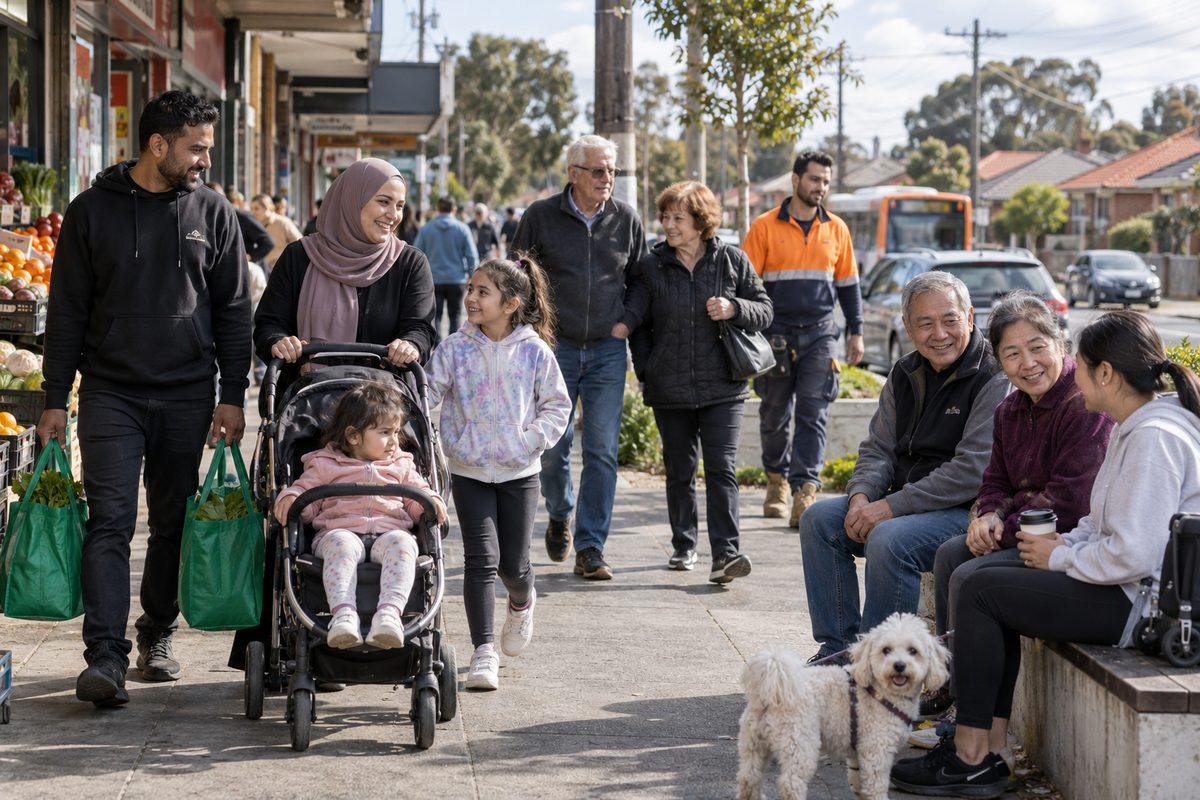
Who Lives in Thomastown? Population, Languages and Census Insights
Thomastown is home to roughly 16,000 to 17,000 people, and it is one of the most culturally mixed suburbs in Melbourne's north. Most residents are working-age adults and families, and a large share speak a language other than English at home. Punjabi, Italian, Arabic, Macedonian and Greek all show up strongly in the data. That mix did not happen by accident. It comes from waves of migration that stretch from German farmers in the 1800s to Punjabi families arriving in recent years.
This guide shows you who lives in Thomastown, Victoria, what the census says, and how to read the numbers without being fooled by them. Exact figures change with every count, so treat the numbers here as a guide and check the latest release for the final word.
Where Do the Numbers Come From?
Every figure about who lives in a suburb traces back to one source: the Australian Bureau of Statistics. The ABS runs the Census in Australia every five years. Households fill in a form on one night, and the ABS turns millions of forms into a profile of each area.
The ABS publishes the results as free QuickStats pages. Search for the suburb name and you get population, age, income, housing, birthplace, ancestry and language. This is the same data that councils, schools, banks and shop owners use to decide where to invest.
One catch matters here. The ABS builds its suburb profiles from a boundary it calls a State Suburb. That boundary can differ slightly from the postcode or from how locals picture the area. If you want to be sure where the edges sit, our guide on where the suburb is placed covers the postcode, the council and the neighbours.
How Many People Live in Thomastown?
The most recent census counted somewhere in the range of 16,000 to 17,000 residents. That is a mid-sized suburb by Melbourne standards. It sits well below the giant growth-corridor suburbs on the city's fringe, and well above a small village.
The population has grown slowly. Thomastown is an established suburb, so there is little empty land left for big new estates. Growth comes from smaller changes: older homes replaced by townhouses, larger households, and newcomers moving into rentals and family homes.
Here is the pattern I see when I compare it with newer suburbs. Fringe suburbs often jump by 30 percent or more between counts. An established suburb like this one moves in single digits. If you hear someone claim the area is booming, check the census before you believe it.
What Is the Typical Resident Like?
The typical resident is a working-age adult in a family household. The median age sits close to the Melbourne average, in the mid to late 30s. You also find a solid group of older residents who bought decades ago and never left.
Households tend to be larger than the city average. Many homes hold two generations, and some hold three. A grandparent, two parents and school-aged children under one roof is a common setup, especially in families with Italian, Macedonian, Greek or Punjabi roots.
Jobs follow the geography. The suburb sits next to large industrial and manufacturing areas, so trades, transport, warehousing, manufacturing and health support work all rank high. Incomes sit below the Melbourne median, which keeps housing costs more reachable than in the inner suburbs.
One of my clients, a small business owner who opened a food shop nearby, told me she nearly priced her products for a \"typical Melbourne\" customer. Then she read the census profile. Household budgets were tighter, families were bigger, and bulk buying mattered. She changed her pack sizes and her sales rose within a month. The data paid for itself.
What Languages Do People Speak in Thomastown?
The English language is still the most common language spoken at home, but it does not cover everyone. A large share of households use a different language first. The ABS groups these under Languages Other Than English, often shortened to LOTE.
Several languages sit near the top of the list:
- Punjabi. The fastest-growing group, driven by recent arrivals from India.
- Italian. A long-standing community from the post-war years.
- Arabic. Families who came from Iraq, Lebanon and other parts of the Middle East.
- Macedonian. Another post-war community that built deep roots in the north.
- Greek. A smaller but steady presence, with strong local clubs and churches.
The exact ranking shifts between counts, and the order of the older European languages tends to slide as the oldest speakers pass away. Newer languages climb. If you want the current order, open the ABS QuickStats page and look at the \"language used at home\" table.
A common mistake is to treat this list as a map of nationalities. Language at home is not the same as birthplace or ancestry. A young person with Italian grandparents may speak only English at home and still count as Italian by ancestry. The census tracks all three questions separately, so read them separately.
Why Is the Punjabi Language Growing So Fast?
The Punjabi language has surged across Melbourne's north over the past decade. Thomastown is one of the suburbs where you see it most. Three forces explain the jump, and they all connect.
First, Australia's skilled and student visa programs brought many people from Punjab. Second, families follow family. One household settles, finds housing and work, and cousins and parents come after. Third, the suburb offers what new arrivals need: affordable rentals, public transport and jobs close by.
You can see this on the street. Grocers stock Punjabi staples, community groups run language classes, and temples and cultural events draw big crowds. Services have followed too. Local clinics, accountants and driving schools now advertise in Punjabi.
When I spoke with a tutor who teaches English to adult learners in the area, she told me most of her new students were Punjabi speakers who already held jobs. They did not need to learn English to survive. They wanted it for promotions and to help their kids with homework. That detail never shows up in a table, but it explains why the numbers keep moving.
How Did Earlier Migrants Shape the Suburb?
The suburb's mix did not begin with Punjabi families. The first European farmers, including German settlers who built a community nearby, arrived in the 1800s. After the Second World War, factories in the north needed workers. Italian, Greek and Macedonian families came for that work and bought modest blocks of land.
Those families built churches, social clubs, bakeries and sports teams. Their children grew up speaking two languages and many stayed close to home. That is why you still see multi-generation homes and long-held family properties today.
Each wave adds a layer rather than replacing the last. Walk down one main street and you can pass an Italian cafe, a Middle Eastern bakery and a Punjabi sweet shop within a few minutes. That layering is the real story behind the numbers.
Where Does Thomastown Sit in the Wider Region?
The suburb lies in Melbourne's north, about 15 to 17 kilometres from the Melbourne central business district. Local government sits with the City of Whittlesea, one of the largest and fastest-growing councils in the state.
This matters for data. Council reports often cover the whole municipality, which includes big new estates on the fringe. Those numbers look very different from the established suburb. If you read a council summary that says the area is young and growing fast, remember that the claim describes the council's outer estates, not necessarily this suburb.
Always check which boundary a statistic uses. The difference between suburb, postcode and council can change a headline completely.
How Reliable Are Census Numbers for One Suburb?
Reliable enough to plan with, but not perfect. Three limits are worth knowing.
- The count is a snapshot. It reflects one night every five years, so it can lag behind fast change.
- Some groups are undercounted. Recent arrivals, renters and shared households may skip the form or be counted at another address.
- Small numbers get adjusted. The ABS makes small random changes to protect privacy, so tiny groups can look slightly off.
For a suburb of this size, these errors are small. Large patterns, like the rise of Punjabi or the long presence of Italian and Greek, are solid. Tiny details, like the exact number of speakers of a small language, deserve caution.
What Does This Mean for Daily Life?
A mixed population changes how a suburb works in ways you can feel.
Schools often run language support and welcome families who speak little English. Councils translate notices and run multilingual events. Shops open for festivals that fall on different dates through the year. Food is cheap, varied and good, because competition between family-run places keeps standards high.
There are trade-offs, and it is better to name them. Some residents struggle to access services when forms and phone lines are only in English. Newer arrivals can feel isolated if their community is small. Services that translate well do far better than those that do not.
If you are thinking about moving in, this is a suburb where you will hear several languages in one afternoon and meet neighbours with very different histories. If you run a business or community group, speak to people in their language and you win trust fast.
How Can You Read the Data Yourself?
You do not need to be an analyst. Follow these steps and you will have a clear profile in ten minutes.
- Search the ABS website for the suburb's QuickStats page.
- Read the population, median age and household size first.
- Open the language table and note the top five languages other than English.
- Compare it with a second suburb, such as one closer to the city, to see what stands out.
- Check the count date and confirm the boundary before you quote anything.
Use the comparison step every time. A number only means something next to another number. A median age of 36 tells you nothing until you see that the Melbourne average is similar.
Your Next Step
Open the ABS QuickStats page for the suburb today and write down three things: the population, the top language other than English, and the median age. Then use them. If you plan to move, visit on a weekend and walk the main shopping strip. If you run a business, adjust one thing about your product or message to fit what the census shows. Real people live behind these numbers, and the best way to understand them is to pair the data with a walk down the street.