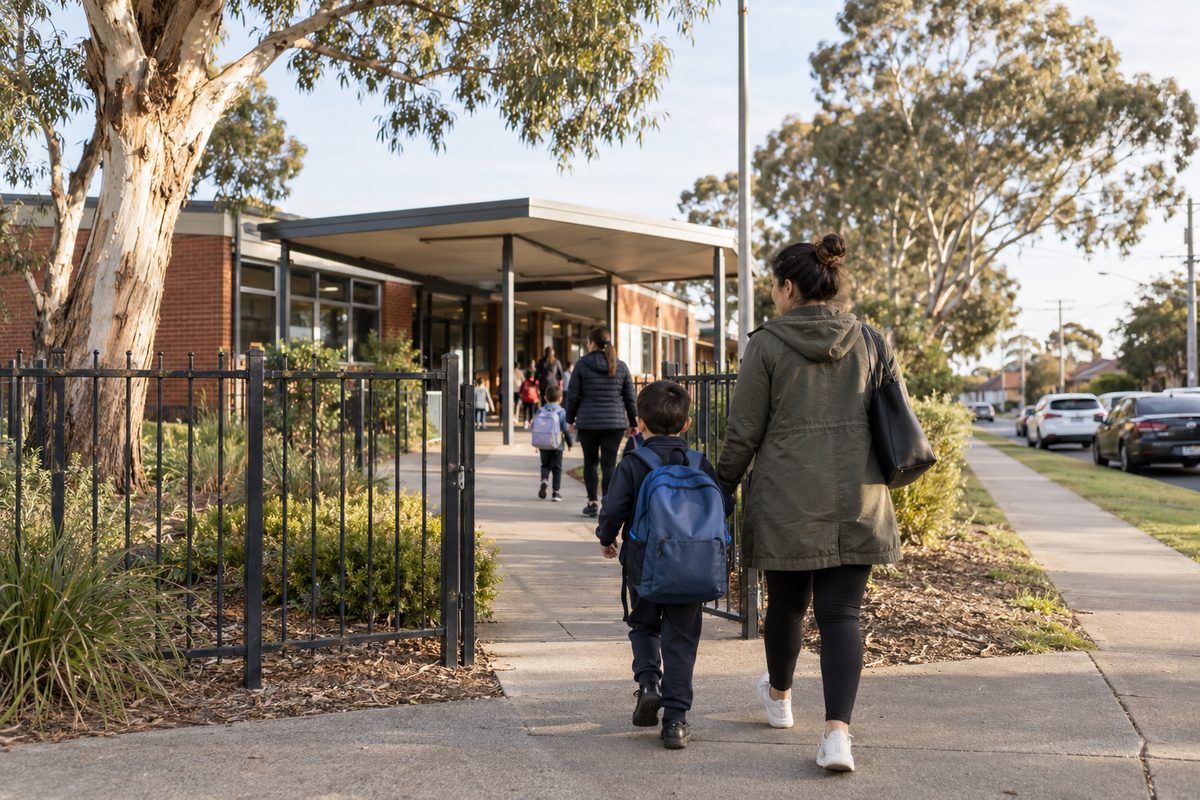
Schools in Thomastown: Locations, Enrolment and School Zones
Thomastown has four main government schools: three primary schools and one secondary college, and your home address decides which one your child has a right to attend. That address-based rule is called a school zone. Get the zone right and enrolment is simple. Get it wrong and you can lose weeks chasing a place at a school that was never going to take you.
This guide covers where the schools sit, how zones work, and the exact steps to enrol. If you are still working out where the suburb sits, start with our guide to Thomastown, Victoria and come back here.
Which Government Schools Serve Thomastown?
Four schools carry the suburb's name. Each one has its own zone, so they are not interchangeable.
- Thomastown Primary School is the original primary school in the older part of the suburb, close to the main shopping area.
- Thomastown West Primary School serves the western side, toward the Edgars Road end of the suburb.
- Thomastown East Primary School serves the eastern streets, closer to the Plenty Road side.
- Thomastown Secondary College is the local government secondary school, taking students from Year 7 onward.
A fifth name often confuses people. Thomastown Meadows Primary School sits in the area too, so check the zone for your exact street before you assume anything from a name.
One of my clients moved to a rental on the west side and enrolled at the first school she found on a map. It was the closest by road, but it was not her zone school. The zone school was a four-minute walk the other way. She lost two weeks fixing it. The lesson is simple: the map shows distance, but the zone map shows your rights.
How Do School Zones Work in Victoria?
The Victoria State Government sets a designated neighbourhood zone for each government school. If you live inside that zone, the school must offer your child a place. Zones are drawn around streets, not around how far you live from the gate.
The Victorian School Building Authority manages the school zone data and the online tool for checking it. You type in your address and it tells you the designated primary and secondary school. That result is the one that counts. A real estate listing, a friend's advice or an old school website does not.
Zones can change. Growth in a suburb pushes some schools to full capacity, and the government can adjust boundaries to ease the pressure. If you are buying a home partly for its school, check the zone close to settlement, not only when you first inspect the house. Ask for the zone result in writing or save a screenshot with the date.
Many people think living in a zone is a luxury perk. It is more practical than that. It is a guarantee, and it protects you from waitlists and out-of-area refusals.
What If Your Street Sits Near a Zone Boundary?
Boundary streets cause most of the stress. Two neighbours across the road from each other can have different zone schools. That is normal.
When this happened to a family I worked with, they assumed the closer school was theirs. The zone tool said otherwise. They rang the school that was not their zone, asked about out-of-zone places, and learned those places only open after all in-zone children are placed. They enrolled in their zone school and later moved their child across when a spot opened. It worked, but only because they started with the correct answer.
If you are on a boundary, do three things in order: run the address through the zone tool, phone the zone school office, and ask what year levels have space. The order matters. Your zone school is the safe base, and everything else is a bonus.
When and How Do You Enrol a Child in Primary School?
A Primary school place in Victoria starts with Prep. Your child must turn five by 30 April in the year they start. Enrolment for the following year opens in Term 2 or Term 3 of the year before, and the schools usually confirm places in Term 3 or early Term 4.
Here is the process:
- Check your zone school with the online zone tool.
- Contact the school office and ask for the enrolment form and the dates for tours.
- Gather your documents: your child's birth certificate or passport, immunisation history statement, and proof of address such as a lease or rates notice.
- Submit the form and book the tour. Most schools prefer a short visit before offering a place.
- Wait for the offer letter and accept it by the deadline.
Proof of address is where people slip. A lease that has not started yet, or a utility bill in a flatmate's name, can stall the process. Use a document with your name and the street address on it. If you are moving mid-year, ring the school and explain. Schools handle mid-year arrivals all the time.
Do not wait for the "perfect" moment. In my experience, families who apply early get calmer outcomes, because the school can plan classes around known numbers.
How Does Secondary School Enrolment Work?
Secondary enrolment follows the same zone logic. Your child's designated secondary school is based on your address, and Thomastown Secondary College takes students inside its zone. Year 7 applications usually open in the year before, often around Term 1 or Term 2 of Year 6.
Primary schools help here. In Year 6 your child's teacher will often hand out information on the transition process. Read it. Transition days let your child visit the secondary school, meet teachers and see the timetable in action. Children who attend those days usually walk into Year 7 with less fear.
If you are not happy with the zone school, you can apply to another government secondary school. Be honest with yourself about the odds. Out-of-zone places go to students after in-zone students are placed, so you need a back-up plan. Never turn down your zone place while you wait for a second choice.
What About Catholic and Independent Options?
Zones apply only to government schools. The Catholic Church runs a network of parish and regional schools across the northern suburbs, and these schools set their own enrolment rules. Many give priority to baptised Catholic children and to families linked to the parish, but most also accept others when places allow.
Catholic and independent schools usually ask you to register early, sometimes at birth or in the first years of life. Fees apply. Ask for a fee schedule and a list of extra charges such as uniforms, camps and levies. Visit during a school day, not only on an open night. An open night is a stage show. A normal Tuesday is the real school.
If you are weighing a government school against a faith school, my advice is to tour both with the same list of questions. Ask about class size, how they handle a child who falls behind, and how they communicate with parents. Compare the answers, not the brochures.
Which Schools Support Families Who Speak Another Language at Home?
Thomastown is a multicultural suburb, and many families speak a language other than English at home. Schools here are used to this. Most offer extra help for students who are still learning the English language as they start.
The program name you will hear is English as a second or foreign language, often shortened to EAL (English as an Additional Language) in Victorian schools. Students who qualify get targeted teaching in small groups or in class. The school assesses your child after enrolment, so you do not need to prove anything in advance.
I once worked with a family who arrived mid-year with a nine-year-old who spoke almost no English. They feared he would be held back. Within a term, he was working in small groups with a teacher who focused on spoken English, and he had made two friends. Their biggest worry turned out to be smaller than they expected.
When you visit a school, ask who runs the EAL support and how often students receive it. Also ask whether the school provides interpreters for parent meetings. A good school will answer without hesitation.
How Do Local Council and Location Affect Your Choice?
Thomastown sits inside the City of Whittlesea, one of the Local government areas of Victoria. The council does not run schools, but it does control the things that surround them: footpaths, crossings, parking rules, libraries and kindergarten support. A school on a quiet street with a safe crossing is a different morning routine from one on a busy road.
Test the trip yourself. Walk or drive the route at 8:30 a.m. on a weekday. Notice where cars queue, where parents park and how long the drop-off takes. That ten-minute test tells you more than any rating.
Neighbouring suburbs matter too. Families on the northern edge may find that a school across the boundary in Epping, Victoria is physically closer than the Thomastown school in their zone. That does not change your zone. It does mean you should check the Epping zone result as well, in case your address falls inside it.
How Does Public Transport Change the School Run?
Thomastown station sits on the Mernda line, which runs through to the city. This matters most for secondary students. A teenager who can catch a train to a sport program, a part-time job or a relative's house gains real independence.
For primary students, the train matters less. Most walk, scooter or ride in a car. For working parents, though, the station is useful for the commute after drop-off. Plan the whole morning in one chain: drop the child, park or walk to the platform, board the train. If the chain breaks at any point, you will feel it every day.
When I tried mapping a family's week on paper, we found that a school two minutes further away saved them twenty minutes of morning rush, because it avoided a busy intersection. Distance is not time.
What Should You Check Before You Commit to a School?
Ratings and test scores are a starting point. They do not tell you whether your child will feel safe, known and challenged. Use a short checklist on your visit:
- Does the principal or a senior leader speak to you directly?
- Do students look comfortable in the corridors?
- How does the school handle bullying, and can they show you the written process?
- What happens when a child needs extra help or extra challenge?
- What are the before-school and after-school care arrangements?
Take notes after each visit, not during. You will talk more freely and the staff will too. Ask your child what they thought, even if they are only five. Children notice who smiles at them.
Also check what building work is planned. The Victorian School Building Authority delivers new buildings, upgrades and classrooms for government schools. A school with a new wing coming may handle growth better than one with full portables and no plan. Ask the school office what is funded and what is only hoped for.
What Mistakes Cost Families the Most Time?
Three patterns come up again and again, and they are all avoidable.
First, families trust the name. A school called Thomastown something is not automatically your school. Use the zone tool.
Second, families apply late. Many wait until the school year is about to start. Offers are made months before, and late applicants face more paperwork and fewer choices.
Third, families skip the phone call. A two-minute call to the school office clears up more than an hour of web searching. Office staff know the zone quirks, the spare places and the document rules.
I know this because a client of mine fixed all three in a single afternoon. She ran her address through the tool, rang her zone school, and booked a tour for the next week. Her child started on day one with a uniform and a teacher who knew her name.
Your Next Step
Do these today, in this order:
- Enter your exact street address in the Victorian school zone tool and save the result with the date.
- Phone your zone school and ask about tour dates and enrolment deadlines.
- Collect your child's birth certificate, immunisation statement and proof of address in one folder.
- Book one tour at your zone school and one at your second-choice school, then compare your notes the same night.
Start with the zone result. Everything else in the process depends on it.